
Join two tables on a shared ID
Join two tables that share an ID.
Attach two tables that share an ID. You get them joined and mapped, with a count of what matched on each side and the rows that did not.
Free to start. No card.
| The join, on URN | Rows |
|---|---|
| Schools on the register, open and closed | 475 |
| Inspection rows, every one matched | 188 |
| Of 222 open schools, not yet inspected | 38 |
Every school on the register stays in, with or without an inspection.
For anyone with two tables and one ID
An asset register and an inspection export.A customer list and a sales report.A site list and a survey.The ID is in both.
The answer needs both.
Matching rows on a shared ID is an attribute join. Keeping every row of the first table, matched or not, makes it a left join.
The rows that do not match are where the questions are. Mapstack counts them on each side and tells you why. Rows with addresses are placed on the map as well as rows with coordinates.
Two real tables
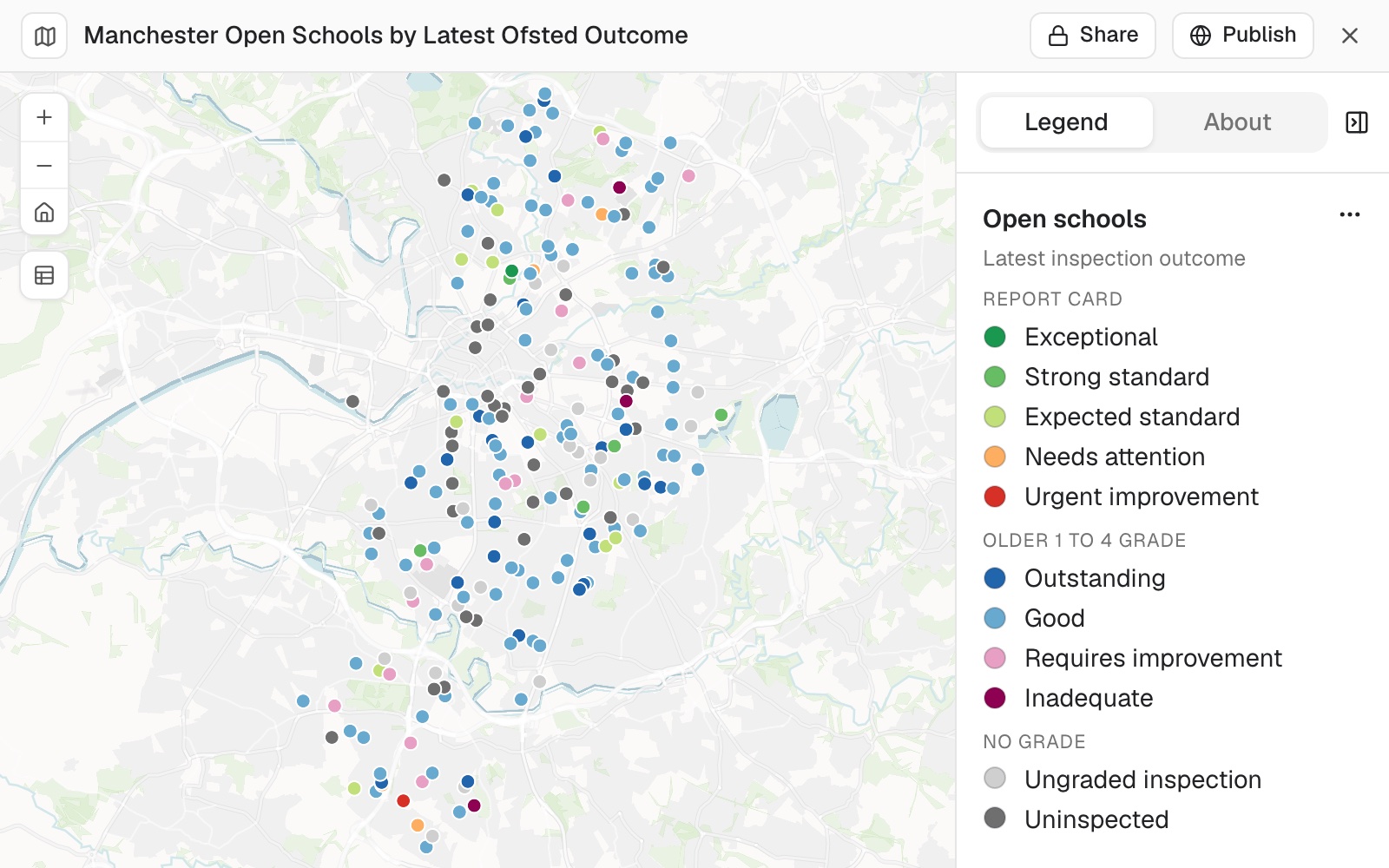
222 open schools, one latest outcome each
The register of Manchester schools and Ofsted's latest inspection results, joined on URN, the reference number every school in England has.
- Matched
- 188inspection rows, every one to a school on the register
- Explained
- 35open schools with no Ofsted row, most of them independent
- Uninspected
- 38of the 222 open schools
- A new report-card grade
- 25
- An older 1 to 4 grade
- 138
- An ungraded inspection only
- 21
- Not yet inspected
- 38
The latest outcome sat in different columns for different schools.
Asked for one column the map could colour by, Mapstack took the report-card grade where there was one, otherwise the latest older grade, and made a second column saying where each value came from.
Department for Education, Get Information About Schools, Manchester, 11 November 2026. Ofsted, state-funded school inspections as at 30 September 2026.
Ask why some did not match
Name the column that decides what you mean, and the answer follows it.
Count only schools whose status is Open. How many have no inspection result, and why might that be?
38 of the 222. Of those, 35 have no Ofsted row: 22 independent schools, 6 colleges and universities, 5 special post-16 providers and two others. The other 3 are new free schools listed by Ofsted but not yet inspected. Independent schools are often inspected by another body, and a school that converts gets a new reference number.
How it goes
You bring the two tables and name the ID. Mapstack does the join and the counting.
Attach both tables and name the shared ID.
Mapstack joins them and maps the result.
You get the match on both sides.
The step-by-step guide is in the documentation: Join two tables on a shared ID and see what didn’t match.
Common questions
What happens to my tables?
It stays in your workspace. Only people with a seat in your workspace can see it. Nothing leaves unless you publish it yourself.
It is not used to train AI. Your data and your conversations are not used to train AI models.
It is still yours. You keep ownership of what you bring in. Delete it and it is removed.
The full answer is in the documentation: Your data, privacy and security.
What does it cost?
Free to start. One seat, for you, with a starter amount of work each month. No card.
This job is on the free seat. Maps, datasets, analysis, your own files and public sharing are all included.
Pay per person for more. A paid seat brings more work each month, and seats for your team.
The prices are on the pricing page.
What does the join keep?
Every row you ask it to. Keep the whole register, and unmatched rows stay with empty columns.
The columns of both. What the map does not show is in the pop-up.
Both tables as they were. Each file is its own dataset. The join is a new one.
Join yours.
Free to start. No card.