

Find where there is room for more stores, and roughly how many
Set your stores and your competitors against population, see which areas are underserved, and get a range for how many more stores the market could take.
Best for
Chains, franchises and their advisers sizing up a city: how many more outlets it could take, and which areas to look at first. Retail, food service, gyms, clinics, anything with a network of sites. You end up with a map of where you, your competitors and nobody trade, a list of the underserved areas, and a range for the number of further stores with the assumptions written down.
The example in this guide sizes up Greater Perth for Guzman y Gomez, a Mexican fast-food chain, against three competitors: Zambrero, Mad Mex and Taco Bell. One file was attached: the stores of all four brands in Greater Perth, taken from each brand's own store finder. Mapstack took the population from the Australian Bureau of Statistics' 2021 Census by SA2 (Statistical Area Level 2, suburbs of roughly 3,000 to 25,000 people). A chain's own sales per store are the best guide to how many people a store needs, and they are not public, so the asks state a rule instead: one store for about 40,000 residents. Results vary from run to run, so treat the figures here as one example.
What you need
- Your stores and your competitors', as a file, or the brands' names for Mapstack to search for in places data.
- The area, such as a city or a region.
- A rule for how many people a store needs, ideally from your own stores' sales. Without one, the count has nothing to stand on.
- A Free, Creator or Creator Max seat.
Before you start
- The count is only as good as the rule. "One store per 40,000 residents" counts residents, not spending, workers or visitors. A store in a city centre or a retail park serves people who do not live there.
- Your own store list beats a search. Named brands can be found in a places database, which leaves out places marked as closed but can still hold a store that has closed or moved, or one entry twice. A list from your own store finder, and your competitors', is current.
The prompt
We run Guzman y Gomez restaurants. Here are our stores and our Mexican fast-food competitors' (Zambrero, Mad Mex, Taco Bell) in Greater Perth. Set them against population by SA2 and show me the areas that are underserved. Assume one of our stores can support about 40,000 residents.
What to expect
It places the stores and fetches the population
Mapstack places each store, fetches census population by area, and counts the stores of each brand in every area. In the example: 19 Guzman y Gomez stores, 57 Zambrero, 7 Mad Mex and 4 Taco Bell, against 2,116,648 residents in 185 SA2s.
It sorts the areas and applies your rule
Each area is put in one of three groups: served by you, served only by competitors, or with no store of any of the brands. In the example that was 19 SA2s with a Guzman y Gomez, 44 with only competitors and 122 with none. The rule then gives a first count: at one store per 40,000 residents, Greater Perth could support about 53 stores, so about 34 more than today. Mapstack lists the largest areas with no store of any brand (Baldivis - South, with 26,046 residents, is first) and the largest served only by competitors (Butler - Merriwa - Ridgewood first, then Morley).
You put it on a map
Yes, make the map: our stores, the competitors, and the SA2s shaded by who trades there.
The map shows every store by brand over the areas shaded by group, with a search by area or store name.
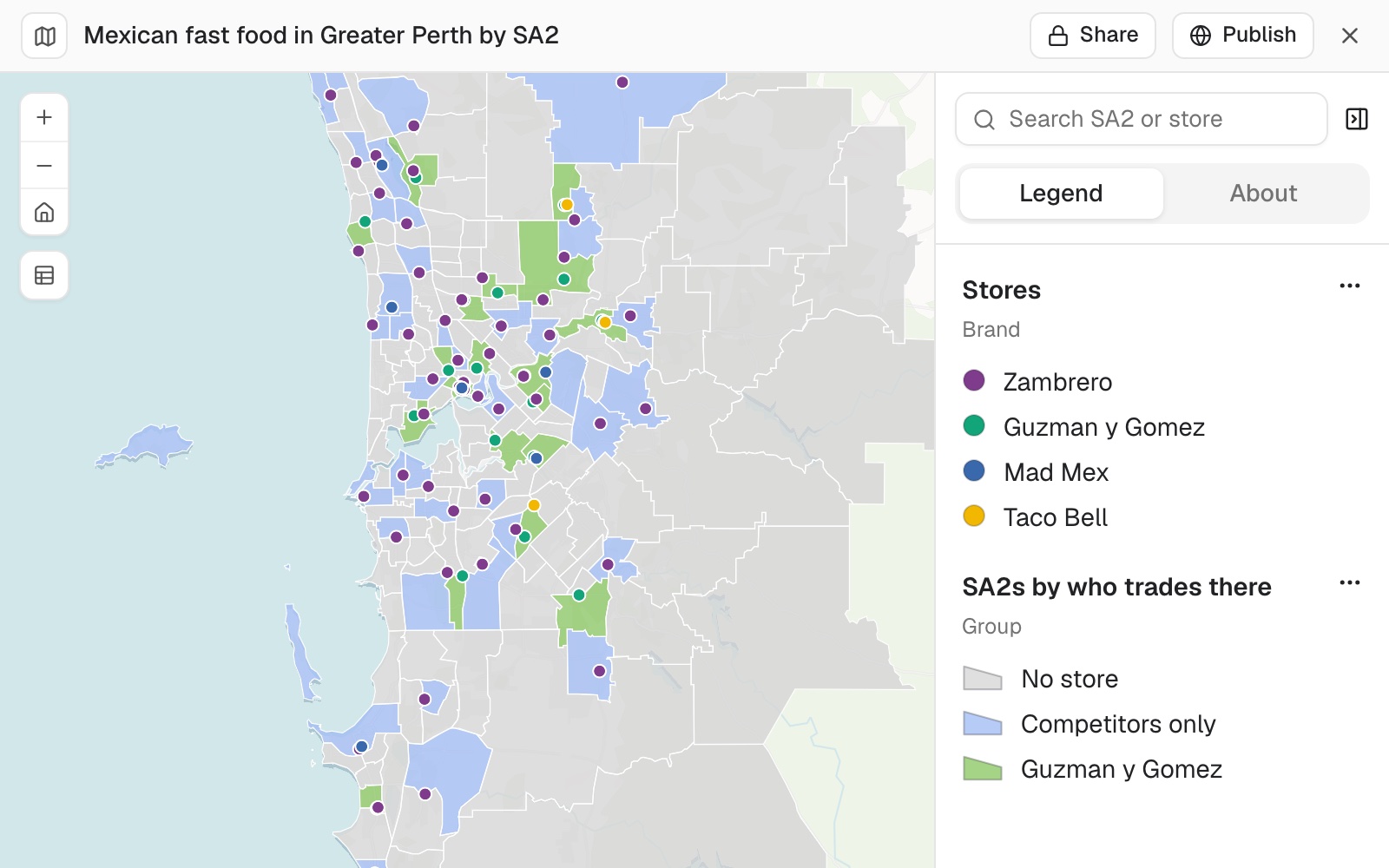 Example: Greater Perth's SA2s by who trades there, Guzman y Gomez (green), only competitors (blue) or none of the four brands (grey), with each brand's stores.
You ask for the number as a range
A single number hides how much it depends on the rule. Ask for a range and the assumptions:
So how many more stores could Greater Perth take, and where? Give me a range and the assumptions behind it.
In the example the range was 23 to 52 more stores, from one store per 50,000 residents to one per 30,000, with the stated rule of 40,000 giving 34. Neighbouring underserved areas were paired into groups of about 40,000 people as places to look first: Thornlie with Huntingdale - Southern River (45,534), and Balga - Mirrabooka with Nollamara - Westminster (40,850).
You check that the figures agree
Add up the parts and compare them with the total. In the example they did not agree, so the next ask said so:
Your two pools add up to 45 stores (29 for the areas with no store plus 16 for the competitor-only areas), but the base case says 34 more. Which is right, and why do they differ?
Both are right, for different questions. The 34 treats the whole city as one market and counts every existing store against it. The 45 counts only the people in areas with no store of yours, and so ignores that your 19 existing stores sit in areas with about 290,000 residents, far fewer than the rule gives them: one is in Malaga, an industrial area with 25 residents, whose customers live and work elsewhere. Which one to plan with is your call.
Common questions
How much does the number depend on the rule?
A lot: the rule is the main assumption. Ask for a range and the assumptions behind it (in the example, 23 to 52 more stores, for one store per 50,000 to one per 30,000 residents), and set the rule from your own stores' sales or customer numbers.
Does it count people who work or shop there but live elsewhere?
No. A rule such as "one store per 40,000 residents" counts residents, not spending, workers or visitors. A store in a city centre or a retail park serves people who do not live there, so read those areas with care.
Can Mapstack find the stores itself?
Yes. Name the brands and the area, and it searches a places database. It leaves out places marked as closed, but a listing can still hold a store that has closed or moved, so check the list against what you know, or attach your own.
How do I check the figures?
Add up the parts and compare them with the total. When two figures for the same thing disagree, ask how each was worked out: in the example, 34 and 45 more stores were both right, for different questions.
Can it forecast sales for a site?
Not from population alone: a forecast needs your own sales and spending data. See Compare two catchments.