

Build a prospect list of every business of one kind in an area
Have Mapstack find every business of one kind in an area, with addresses and contact details, as a list to load into your CRM and a map.
Best for
Sales and marketing teams who need a target list for a territory: every gym in a city, every dental practice in a county, every café near a depot. You end up with one row per business, with its address and the phone, website and email where they are published, ready to download for your CRM, and a map for planning visits.
The example in this guide uses no file of your own. Mapstack finds the businesses itself, in Overture Maps, an open dataset of places around the world: the gyms and fitness centres of the Leeds district, UK. Every ask below is part of that one example. Results vary from run to run, so treat the figures here as one example.
What you need
- The kind of business, in your own words, and the area. Name a city, a county or a region.
- What a row should hold: name, address, phone, website, email, or whatever your CRM imports.
- A Free, Creator or Creator Max seat.
Before you start
- No list of places is complete. Open place data can miss businesses and can still list some that have closed. Treat the result as a strong start that your reps will correct.
- Contact details are only those published. Where a business has no phone or email in the source, the field is empty.
- Contact details can be personal data. A sole trader's phone or email may be covered by privacy law where you are. Check how you are allowed to use them before a campaign.
The prompt
Build me a prospect list of every gym and fitness centre in Leeds, UK, for our sales reps: name, address, phone, website and email where you have them, one row per gym, nothing permanently closed, as a list I can load into our CRM. And a map of them.
What to expect
Mapstack finds the businesses and judges each one
It searches the area for the categories that fit what you described and judges each place against your request. It merges listings it judges to be the same place, flags possible duplicates for you to decide, and leaves out places closed for good.
It tells you what it did. In the example: 354 gyms, fitness centres and studios, 21 duplicate listings merged, 8 places closed for good left out, and 90 more left out as not what was asked for (sports clubs, martial arts and dance schools, climbing walls, children's play centres, and listings that were only a person's name or a street address), with an offer to bring them back. It names the Overture Maps release used.
It makes the map
The map colours each place by its category, with a popup holding the phone, email, address and website, a search box and a table.
You narrow it to the prospects that fit
Say who you actually sell to. In the example the target was independent gyms:
Mark each gym as chain or independent, then give me a list of only the independents. How many are left, and how many of those have a phone number or an email?
Mapstack makes the narrower list as a new dataset and counts what you asked: 314 independents, 285 of them with a phone number or an email.
You check the list the way you would a colleague’s
Search the list for the names you know. Telling a chain from an independent is a judgement made from the names, brands and websites in the data, and a branch listed without its brand reads like an independent. In the example a search found a Pure Gym, The Gym Leeds Headrow, Virgin Active and the two Village gyms still on the independent list, and the council's leisure centres too:
Pure Gym, The Gym Leeds Headrow, Virgin Active and the two Village gyms are chains, and the council leisure centres aren't independent businesses either. Check every name on both lists again, move any that are on the wrong one, and tell me what you moved and the new totals.
Mapstack checked every name and moved 60 places off the independent list (26 chain gyms and hotel health clubs, and 34 council, university and other public centres) and 8 onto it, such as two CrossFit gyms the data had tagged with the CrossFit brand, which are independently owned. The new totals: 262 independents, 234 with a phone number or an email.
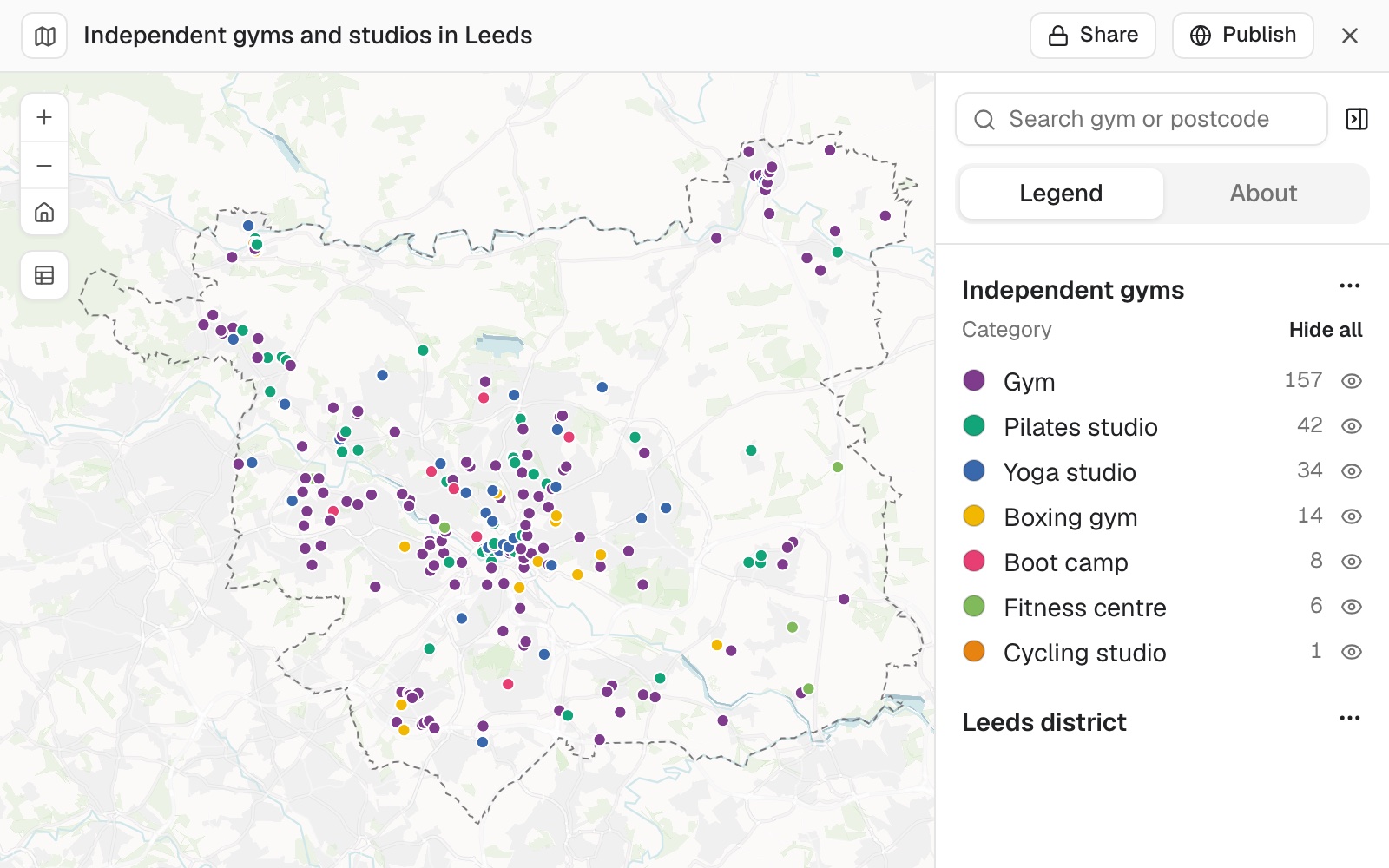 Example: the 262 independent gyms and studios in the Leeds district, coloured by category.
You split it for your reps
Ask for the list in the order your team works, such as by postcode district (the ask is under Make it your own). In the example Mapstack added a postcode district column, sorted by it and counted each district: 234 in 27 Leeds (LS) districts, 6 with Bradford or Wakefield postcodes that still fall inside the Leeds district, 20 with no postcode in the source, and 2 with a postcode far from Leeds, which it read as a head office or billing address in the source data.
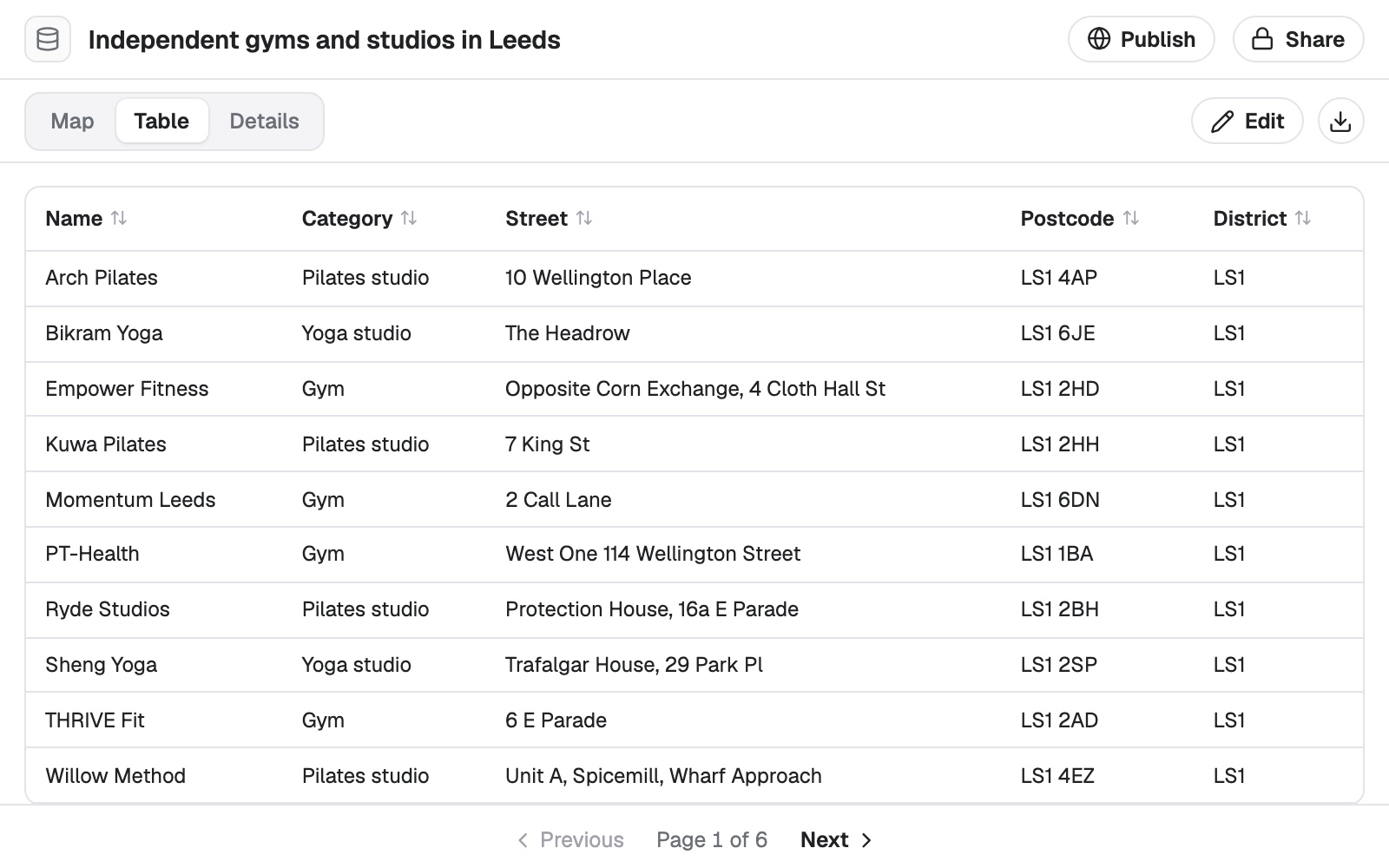 Example: the independent list sorted by postcode district, 262 rows, ready to download for the CRM.
You take the list away
Open the dataset and select Download, then Spreadsheet for a .csv your CRM can import. Each row keeps any possible duplicate group, so your reps can see which entries to check first. See Download and export.
Make it your own
Sort the independent list by postcode so I can split it between reps, and tell me how many are in each postcode district.
Common questions
Is this every business of that kind in the area?
It is a strong start, not a complete list. Open place data can miss a business, hold it under another category, or still list one that has closed. If you know one is missing, ask for the wider category, or add the row to the dataset yourself.
How do I take out the places I don't sell to?
Say what to leave out, for example "a list of only the independents". Mapstack makes the narrower list as a new dataset and says how many are left.
How do I check the list?
Search it for the names you know. Telling a chain from an independent is a judgement made from the names, brands and websites in the data, so name any chains you find and ask: "Check every name on both lists again, and tell me what you moved and the new totals."
Why are some contact details empty?
The source has none published for that business. Mapstack gives only the phone, website and email that are published.
Can I correct a row, or remove a business that has closed?
Yes. Correct the value or delete the row in the dataset. See Edit a dataset.